If it feels predatory, dehumanising and ableist then it probably is.

If it feels predatory, dehumanising and ableist then it probably is.

art resources
If it feels predatory, dehumanising and ableist then it probably is.

This is a difficult blog to write because it is going to highlight some traumatising experiences I have experienced in the arts and a few other neurodivergent artists have had very similar experiences.

If anything is going to change in the arts then it needs to be written otherwise this behaviour and these policies just continue…

So… without further ado, everything that is wrong with this ableist email:

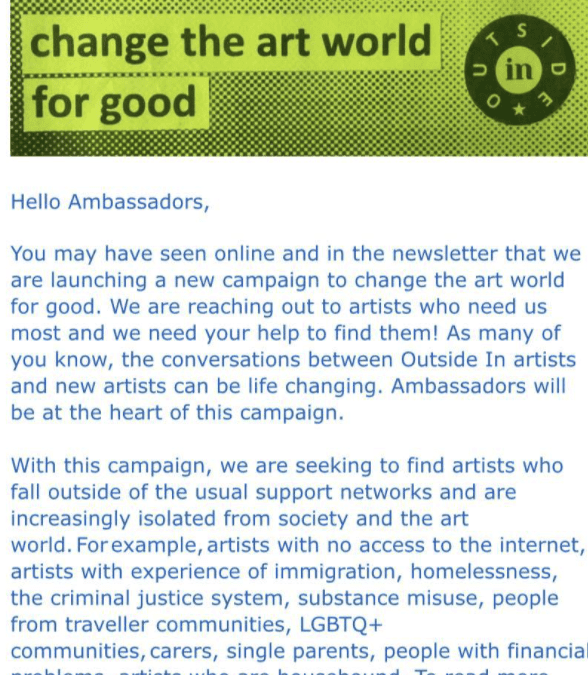
Text in the email screenshot above reads:

Hello Ambassadors, 

You may have seen online and in the newsletter that we are launching a new campaign to change the art world for good. We are reaching out to artists who need us most and we need your help to find them! As many of you know, the conversations between Outside In artists and new artists can be life changing. Ambassadors will be at the heart of this campaign. 

With this campaign, we are seeking to find artists who fall outside of the usual support networks and are increasingly isolated from society and the art world. For example, artists with no access to the internet, artists with experience of immigration, homelessness, the criminal justice system, substance misuse, people from traveller communities, LGBTQ+ communities, carers, single parents, people with financial problems, artists who are housebound. To read more about the campaign, please click here.  We have newly-designed flyers and posters which will be winging their way out into the world, with your help. 

You can help Outside In in two ways:

1. Researching new organisations that we can send flyers to. This would be spending some time online searching for new organisations in your area and sending us what you find. This could be on an Excel spreadsheet template or we can post you a paper copy to fill in by hand. There is no minimum time you need to spend on this – it could be anything from 1 hour upwards, we appreciate any time you can spare.

2. Giving out flyers in your local community. The flyers will be ready to give out in March after all the research is complete. If you’re on social media, we would also like you to take a picture and post it using the tag @ChangeTheArtWorldForGood if you would like to do this. If you would simply like to give out the flyers but aren’t able to do the research, that is OK too. Please send me your details and I will send you a pack when they are printed.

If you would like to get involved, we are running information sessions to share more about the campaign and why it is so important, and also to give you research skills and advice on making connections with new organisations and artists. Marc Steene, Director of Outside In, will be introducing the campaign. The sessions will be on Zoom on the following dates:

  • Tuesday 15th February 10.30am – 12pm

  • Tuesday 1st March 10.30am – 12pm

Please let me know if you’d like to come to one and which date is best for you. If you would like to help but are unable to come along to either of these dates, please let me know and we can arrange to talk on a one-to-one basis.

Also, if you have existing links to any organisations we could reach out to with flyers and a poster, please do send me their details.

Outside In really appreciate any time you can give to support the campaign and change the artworld for good.

Before I set up Magical Women, which was a direct result of an extremely troubling and traumatising experience at Outside In’s training to become an Ambassador, I didn’t know how to complain to Outside In, or even explain to them that their training and policies are incredibly trauma inducing for neurodivergent particularly autistic people.

Receiving this email brings it all up again.

During the training session, the woman leading the training interrupted me during a role play to be incredibly condescending correcting me and telling me how to say and do things. I completely shut down, and went mute. Then I burst into tears. My group were very kind but told me the woman was ableist and obviously ignorant of neurodivergent people and to ignore her.

The same woman who had boasted she’s been a part of Outside In since its conception, and that she’s one of the longest serving members in their staff team, told us that Ambassadors were there to represent Outside In and not there for their own art practice. There were about 20 disabled and neurodivergent artists in this Ambassador training session, and the woman told us a story about how this one Ambassador was talking about Outside In with a potential “donor” and then began to talk about their art and then the “donor” wanted to buy their art. The woman explained “The Ambassador in this case was very unprofessional and put themselves in a sticky situation. What things had the ambassador done wrong?”

People put their hands up saying “They shouldn’t have talked about their art”

or “They should have only talked about Outside In.”

Yes, the woman explained, they’re not there about themselves or their art practice… it’s about making money for Outside In so that Outside In can continue to do its good work.

Now this deeply troubled me because then, what was Outside In’s aims?

Surely, a disabled arts organisation who showcases disabled artists should be out to supporting those artists to sustain their arts practice?

What’s so wrong with the artist selling their work?

The donor was genuinely interested in what the Ambassador had to say, and anyway, Outside In takes a cut of 25%, so surely, win win:

Win for Outside In – they get a 25% donation and win for the disabled artist who experiences significant challenges and barriers in their practice – they get a sale – an absolute rarity for neurodivergent artists but no…

This woman was more intent on demonising the disabled artist, the “Ambassador” for not fulfilling their role. (A role, let’s not forget, this Ambassador was doing unpaid!)

Imagine being that Ambassador for a second.

Imagine having someone interested in your art practice and you and offering to buy your work but the organisation you’re there representing not only tells you the donor can’t buy your work but then begins making you feel absolutely awful for “making a mistake” or “for making it all about you.”

I don’t know if I’ve missed the boat or something… but surely that’s autism…. sharing our OWN experiences is how we connect to people?

Or have Outside In, forgotten about us? About the people they supposedly represent…

Let’s look at that Ambassador again – so this person is disabled, neurodivergent and faces huge barriers in life, they have probably been excluded, bullied and teased and now they’re being used as an “example” of what not to be or do on a training course.

It’s harmful

It’s dangerous

And, friends, it made me cry.

Let’s look at this role of being an Ambassador for Outside In more closely shall we….

The role of an Outside In Ambassador is to “sell” Outside In to organisations and invited (very rich) people to art exhibitions in swanky spaces or environments to ensure that these rich people and organisations pay lots and lots of money to Outside In… so Outside In can continue with Inspiration Porn and Exploitation of disabled artists.

So essentially, Outside In are using desperate disabled artists by NOT paying them or covering their expenses to promote the work of Outside In…. sounds pretty predatory, dehumanising and ableist to me.

I had art selected and exhibited in a big swanky space, I even had a photo with Grayson Perry, who didn’t select any women in the finalists – same old same old 3 white men were chosen for 1st, 2nd, 3rd prize – and of course they didn’t come up for their awards but the manager of the community centre where they make art did.

Who gains from the prize?

The prize was £1000 and to exhibit at a renowned art gallery.

Did any autistic artists with no learning disabilities get chosen? No?

Did any autistic artists who have faced/experienced homelessness, lack of benefits and had to fight the system get chosen? No?

Did any autistic artists who are independent but struggling and may be survivors of MH or violence get chosen? No?

Did any autistic women get chosen? No?

Did any trans or marginalised identities identifying artists get chosen? No?

Yet, these are the very artists chosen to be ambassadors.

They’re not “disabled” enough to win prizes, but they’re disabled/desperate enough to sell the scheme to rich donors.

And they’re desperate because they meet and face so many barriers.

But let me tell you, neurodivergent people are skilled and talented and they need more help than a workshop or a showcase in a big swanky space, they need funding to sustain their practice.

Why is this email I received in my inbox so troubling?

1) They are not paying the Ambassadors to do this work for them.

If we want to really make a change in the arts – we will pay neurodivergent (“outsider”) artists whenever we ask them to do anything.

Why will we pay them? Because we respect their worth as artists.

2) They want more artists from these different demographics but then what? To exploit them even more? Just because you showcase their work doesn’t mean anything. When MW was funded, although we were funded on a small amount, artists were paid for their contributions.

We are seeking to find artists who fall outside of the usual support networks and are increasingly isolated from society and the art world. For example, artists with no access to the internet, artists with experience of immigration, homelessness, the criminal justice system, substance misuse, people from traveller communities, LGBTQ+ communities, carers, single parents, people with financial problems, artists who are housebound. 

No. Until they see that they are running on very dangerous medical model policies, they will NOT be able to make any kind of change in the art world.

Until they read their complaints emails and actually identify they are being exploitative and ableist, then their ableist and exploitative policies and actions will rage on.

Neurodivergent… “outsider” artists require to be paid for their time doing any type of work.

What do they get in return?

They are not there to wave the flag for Outside In, they believe or hope that through being showcased by Outside In that they will sell their artwork. But this rarely happens.

Another neurodivergent artist went on a training to learn how to write an artist statement. They told me it was incredibly traumatising and they made a complaint that again, was shut down by the team. This white non disabled team.

From an Outside In training

What is wrong with the training slide above?

The problem with the wording above in the slide – is that this is anti-neurodivergence and it is also telling neurodivergent people to not be neurodivergent. “Outsider artists, you need to stop being outsiders.”

This is the very narrative that demonises disabled artists and excludes them even further.

It is up there with the medical model waving the flag for them.

It panders to existing societal power structures: make sure your spelling and sentence structures are good etc.

Instead, they should be teaching artists about Access to Work and how they can get a proof reader and access worker from Access to Work so that they don’t have to feel inadequate any longer, but have someone to support them with their work.

From a neurodivergent artist on this workshop where this slide was used: “Do not use ‘unusual’ or flouncy words to describe your work (which I personally love to use and part of what makes me me). Anyway i’m pretty sure one of the words on their example ‘no’ list was Magical….I called them out on it in the workshop and again over the phone or by email.”

So if I’m not the only one calling them out, but so are other neurodivergent artists, then why are they not listening to us, and instead sending us more crap?!

Change in the art world can only happen if you start to listen to us and let us lead.

What’s the incentive to alleviate the poverty and degrading circumstances that marginalised people experience when your charity, Outside In, is directly benefiting from its continued existence?

How you can ask for Access Support for Funding Applications

How you can ask for Access Support for Funding Applications

art resources
How you can ask for Access Support for Funding Applications

Whilst these resources are free, contributors are doing this unpaid, if you can afford to buy them a coffee/donate, then we encourage £3 – DONATE A COFFE

Many neurodivergent artists don’t realise that they can get paid access support when applying for funding.

This guide will explain in very simple terms and provide a template email for you to use whenever you want access support with filling in your funding application.

Remember:

You are simply asking to reduce your barriers so you can send off that funding application! It is in the arts organisation’s interest to read your extremely interesting and exciting funding application! They can’t do that if you can’t get them the funding application!

1) If you’re new to applying for funding to fund your art or writing practice, you might not be aware of some arts organisations that support disabled artists to reduce their access barriers so you can apply for funding!

These organisations are worth looking up, they offer funding or call out opportunities you can apply to:

  • Disability Arts Online

  • Arts Council England (If you’re based in England)

  • A-N

  • Also look up other Call Outs and Opportunities on the Arts Jobs website

2) When you find an opportunity you want to apply to, or want to make a funding application, look out for the email that might invite you to email and ask for access support with the form.

“If you need access support to fill in the form please contact [email address]”

This is the part you need to find in the information part about the how to fill in the application form.

3) When you find the email address, identify who you would like to use to support you with the funding application. Here at Magical Women, we can support you with some funding applications but we cannot help with more complicated budgets, for that we highly recommend a fundraiser we work with so do email us for their name.

4) Use the template email below to send to the funding organisation to ask for access support:

Dear (Organisation name) team, (if you don’t have a name, if you have a name use their name)

I am a disabled artist and require access support to fill in the funding application.

I have approached XYZ to help me fill in the application form. Their cost is £(number)/day. They will need (number) days for the application form.

Please let me know what the next steps are.

Thank you,

(Your name)

Example:

Dear ACE team,

I am a disabled artist and require access support to fill in the funding application.

I have approached Elinor Rowlands to help me fill in the application form. Their cost is £200/day. They will need 3 days for the application form.

Please let me know what the next steps are.

Thank you,

Stephanie

Usually access workers who support you to fill in the application form charge between £200-£250 per day, and Arts Council England usually gives approximate 3 days as a guide. 2 days would be on the lower end for a longer application. Some organisations will tell you a maximum amount of days they allow for access support.

5) It’s always worth asking a funding organisation if they provide access support.

6) Remember! If forms fill you with dread, if you struggle to understand questions then you need access support!

7) What if it goes wrong?

Do remember, if you’re not gelling with your access support, then it might not be a good fit. I have noticed that sometimes people in these roles aren’t very good at it… they might use you for money etc. If this happens don’t panic! Simply write to them and thank them for their help but say you want to pause on the application form.

Then approach the organisation and ask them if they have a list of access workers or whether they could recommend someone.

Whilst they might not be able to recommend anyone, they might be able to provide you a list, or you can approach us to help you.

We are all completely individual and all have our own needs, and it’s important your access worker understands you and knows what you’re trying to say.

We hope this Guide has helped and that you feel more confident to approach an organisation for access support with the funding application process and form.

Challenging the assumption: You can’t be a paid mentor and be receiving mentoring

Challenging the assumption: You can’t be a paid mentor and be receiving mentoring

art resources
Challenging the assumption: You can’t be a paid mentor and be receiving mentoring

In this article we are going to discover the differences between “Describe your practice” and “Your artist statement”

For so long I didn’t put myself forward because I identified that I too struggled and was struggling and needed access support.

I felt conscious that non autistic people would devalue me as a psychotherapist and mentor. Once I was explicit with a parent about my autism when they commented on how transforming I was to their child, and using my autism as a reason why I notice things that others might not, I saw the blood drain from their face, and they made their excuses and I never heard from them again…

Even coming out as having ADHD to my employers at different times was hard enough, because whilst it was within Disability Services at various universities, only dyslexia or a physical disability are “accepted” as not part of their intelligence or capability as humans…. yet, I’ve known many wonderful disabled employees lose their jobs or pushed out because they’re too “slow” at their job even though they are effective, excellent and brilliant at it.

I was pushed out of mine for being too fast, hitting my targets, being 3 months ahead and the disabled university students found me accessible, I had built them a multi lingual website that signposted them to counselling services in over 40 languages in London. A male colleague got so frustrated that I knew my job so well he attempted to teach me a lesson by showing me how to use the phone in front of everyone in the open plan office. As many autistic people can contest to, we are detail orientated… and so I made a complaint about his sexism and ableism… and when they found out I was autistic, it was easier to push me out, than deal with his derogatory behaviour.

On this experience my ADHD specialist identified it was my co-morbid autism and ADHD condition that really can rile up colleagues who want to take out their incapability on me… so what did I do?

I realised that I don’t thrive on competition but work in a collaborative context.

What do you choose? An empathetic and effective boss, or one who only hits targets but who is nasty, unkind and awful to disabled students?

The same I see happening in the “access support” arena, those who can talk the talk and come across as an amazing coach or mentor, are getting all the clients.

A well known ADHD coaching company was putting out an advert for their PA who needed more hours and would any other coach or mentor want them? I applied to the advert as I required a new PA, the ADHD coach only talked at me and wasn’t interested in hearing me at all, when I explained I was autistic and had processing delay so could she slow down, I could hear the ableism in her voice as she made her excuses that her PA wouldn’t be a good fit and then she hung up.

Stunned at the ableism at my mention of autism… I’ve been stunned by a few “ADHD only” groups that again look down on autism.

Yet, they’re getting all the clients because they have excellent sales technique.

I have awful sales technique – just look at the followers for Magical Women – we were once told, “You have a really unique selling point and your social media follows should be into the thousands” and I acknowledge that but I am awful at hooking people in at a consistency that I can keep up with. (Not just because I’m autistic, but because I have chronic illnesses and conditions I can’t keep up the momentum and because of the large gaps, so then we lose followers.

So conscious of my inability to keep up the momentum… and conscious of the discrimination against autistic people and the unconscious bias autistic mental health professionals experience, I remained as someone with ADHD but keeping the autistic part quiet except in workshops or 1:1 with students who I knew would feel more supported by having an autistic coach or mentor.

So I never put myself forward for arts mentoring or consultancy positions but no more, I’ve decided to be open about being both autistic with ADHD and dyspraxic with verbal dyslexia (using the wrong words and mixing up words)

For the past 15 years I’ve been working as a Specialist Mentor, Academic advisor and study skills tutor with disabled students (mainly neurodivergent students) and those with chronic health conditions at universities across the UK and in China.

Testimonials from my university students all highlight how transformative I am to their studies, their marks, access to their exams and their employment opportunities.

But… unlike many other mentors and consultants who are able to ask for £100 a pop or the likes…. I remain unable to ask for that and wonder if it’s part of my neurodivergence? My autism and ADHD traits prevents me from identifying my worth and also knowing how to put myself out there.

I see a wonderful mentor, who has offered their insight and support pro bono because she recognises my low income background and my struggle. I also receive support from the National Autistic Society ASSIST which has been fundamental in my access, my care, and my ability to sound out everything in my head without fear of prejudice, assumptions or being triggered.

When we think of CEOs and psychotherapists – they all have assistants, and supervision – to keep themselves safe and also in “working order” they too need the “scaffolding” and the support but because I am disabled, autistic, and have chronic conditions imposter syndrome is drilled in deep.

So no more, yes, I require access support to keep on top of invoicing, and to sometimes write emails and have templates etc but that doesn’t mean that I’m not skilled.

A skilled mentor is one who shares their skills but also ensures they are effective mentors. I see the fact that I go for mentoring myself as further dedication to the craft that is mentoring.

So for those of you who are struggling with the concept of being able to help others but can’t unless you too receive support – just see it as making yourself an even more effective access support.

The access support I offer my clients and students ensures they can access their studies, their employment and further their (arts) practice.

I’ve supported autistic and ADHD graduates into high paying jobs, and supported art graduates with funding applications.

The access support I receive ensures I can be the most effective for my students and my clients.

And it also means that if I can’t do something, that I can be honest with my clients “Actually, I find this budget form bit a little tricky, my assistant will take a look for me.”

A second pair of eyes is essential.

I hope this article has been helpful to you in identifying what kind of mentor or coach you’d like to approach in the future.

I am an art psychotherapist, mentor, tutor and practitioner who requires access support to stay in employment, to stay effective and be effective for when I practice and work with you and others.

Describe your practice vs. Your artist statement

Describe your practice vs. Your artist statement

art resources
Describe your practice vs. Your artist statement

In this article we are going to discover the differences between “Describe your practice” and “Your artist statement”

Your artist statement must be in your voice.

If it’s not in your voice then it’s not going to work.

Your voice is unique to you.

There are many ableist and anti-neurodivergent workshops out there that will attempt to shame you into thinking your neurodivergent voice is wrong and needs to be erased or wiped out.

They will tell you that your vocabulary is wrong.

The way you use words are wrong and your tenses are wrong.

If you want to be grammatically correct, you can use a proof reader or access support to rewrite your artist statement for you. But, your voice should exhilarate the paragraph (see what I did there? I used a word neurotypical people would frown at… but a word that is exactly how I intended to use it!)

So how are all these access and art resources different to about 99% other art and access resources? Well, they are not encouraging you to overcome, change, or be rid of your neurodivergence.

Instead, they focus on helping you to access the necessary systems and structures in the arts but in a way that is empowering and autonomous for you as an artist.

So… without further ado (you’ll notice I do this a lot!) let’s continue.

I wrote one of the first blog posts on the artist statement but that was quite formal, now we’re going to play a little game.

There are NO right answers by the way. There are only YOUR answers.

1) What is your name?

2) Where did you study if you studied somewhere, if you didn’t, are you self- taught?

3) What inspires you (but try not to use the word inspires in the sentence… instead, focus on 3 things, objects, or themes etc that influence your work.

4) Your 3 favourite words when you look at your art practice.

5) 5 words or sentences that come up for you when you look at your art.

6) What is your art trying to tell you?

7) If your art could speak, what would be their biggest secret?

8) How would you like your art practice to make space for you or connect with you?

I will now show you an example:

1) What is your name?

Elinor Rowlands

2) Where did you study if you studied somewhere, if you didn’t, are you self- taught?

Goodness! Lots of places, but let’s keep to Aberystwyth University, Central St Martins and Roehampton University.

3) What inspires you (but try not to use the word inspires in the sentence… instead, focus on 3 things, objects, or themes etc that influence your work.

The sea, the switching or swaying of moods , deeply felt emotions/colours.

4) Your 3 favourite words when you look at your art practice.

Conjuring, movement, transcendence

5) 5 words or sentences that come up for you when you look at your art.

Feminine gaze, dreamy world-building, emotively loud, trespassing over territories using my hands, textures

6) What is your art trying to tell you?

“It’s warm in here, won’t you come in and play a while.”

7) If your art could speak, what would be their biggest secret?

That it could hear you up in the sky and longed to speak back to you when you were four.

8) How would you like your art practice to make space for you or connect with you?

I would like for it to slow me down, and help me progress on my practice in time, to follow a series.

Now, I wouldn’t use the above for both Describe your Practice and your artist statement but what I’m trying to do is relieve you from the pressure to conform.

You don’t need to conform.

Don’t change your voice.

So, your artist statement is a brief introduction into your practice using your voice for example:

Sammy Hughes is a fine artist working in oils and soft pastels. She is fascinated by the way the light can transform landscapes just by how it reflects colour across the sky.

Hughes is a self-taught artist who begun in soft pastels and soon switched to using oil as she prefers its texture on canvas.

She is transformed each time she paints because she feels the magic brewing between the layers she uses upon her handmade canvases.

Each canvas is created using sustainable materials and she is committed to delivering high quality pieces to her clients. She rarely does commissions because she works to the light in the sky. Each landscape is unique and a document to the end of the day.

So this is an example of an Artist Statement – inside of it is the artist’s language and vocabulary, we get a sense of who she is and we feel present with her whilst she is painting. This is what you want from an artist statement.

For more support with Artist statements/Artist bios go to this blog post here.

Describe your practice

Now, Describe Your Practice is definitely more formal but it is also the first question you often find in a call out or a funding application.

You’ll want to begin here, get a pen and paper, or type in a word document/notes the answers to these questions:

1) What is your practice? (Choose as many as you want)

Visual artist

Painter, soft pastels, drawing, printing

Photographer

Video artist

Sound artist

Digital artist

Live Artist

Dancer

Performance artist

Performer

Actor

Movement artist

Text bast artist

Writer

Musician

etc. (I can list more but these are just examples)

2) How do you attend to your practice?

a) What kind of qualities/skills do you bring to your practice?

b) What are you trying to do?

c) What do you do?

3) Name the most recent projects or exhibitions you have worked on. (6 maximum – depending on word count)

  • Always state if an exhibition was a group or solo one.

  • Always put the title of the show, the curator name or company producing it, the location.

4) What is the purpose behind your work? (The raison d’etre) – The reason for being

Remember there are no right or wrong answers. Here’s an example (please note, everything written below is made up – the exhibitions do not actually exist in real life):

I am a documentary photographer and video artist. I use camera film as opposed to digital cameras in my practice and I am fascinated with the stories that the people I photograph bring to the table. The people I photograph are the ordinary, the everyday, the invisible. They are the people you pass on the street without a second glance. Yet, for me, it’s that exact reason that makes them so interesting. Their stories deserve to be told as do their portraits. I take photographs of my subjects coming out of the sea. The way their clothes stick to them brings an ethereal quality to their stories. My work poses the questions about place and refuge. This is why placing them in the sea and coming out of it is so pertinent to my practice.

Recent solo exhibitions include “How the light lies” at the World’s Photography Exhibition, curated by Day 4 Studios, in Poland and “Where the light lives” at Kingston Gallery, Brighton, UK.

My work brings people together in discussion, its quirkiness also asks important questions about displacement, refugees and how we are to welcome them to our shores.

I hope that this article though a little quirky, has shone a light on the differences between the two, and why it’s important to know the difference when applying for funding or to call outs, and when introducing audiences, clients and customers to your work.

Journeys – Accessibility – Access to Work

Journeys – Accessibility – Access to Work

art resources
Journeys – Accessibility – Access to Work

This article is about making journeys as a neurodivergent artist and the types of access required and needed, and how to ask for it.

In 2013, after working as a Specialist Mentor at a University for 4 years, I was incredibly sad to need to leave but I had to…. I just wasn’t able to make the journeys in to work anymore. I would also need to leave the country. My parents lived abroad and I relied on them to either drive me to work, or they’d drop me off at the bus stop and the buses would drop me off directly outside where I would work.

The buses abroad in the country I grew up in are vastly different to the ones in the UK – not necessarily “better” but far more accessible. No one sits next to each other and so “smells” and other strong sensory features have much less negative effect on me. I still struggle to take the bus though, but I can “get through it” just about.

At work… (back in the UK)

My boss asked me if everything was okay.

I shook my head.

Perhaps, it’s also important to point out here that my boss was disabled and was blind, and I at the time with a clubfoot, chronic fatigue, chronic pain and had had an embolism just two years before affecting my breathing, and making me experience the worst vertigo, all this on top of my autistic, ADHD and dyspraxic traits.

She asked me what was wrong.

I said that I was in so much pain and getting to work was getting increasingly difficult for me. I explained that it had been easier when I was getting journeys to work via taxi as a student (I’d studied my Masters there only a year earlier and had gotten this job through my studies, my boss had also been fundamental in my getting taxi journeys when I was a student) and they’d been life saving, but here now, as an employee, I was struggling.

“Have you heard of Access to Work?” I hadn’t.

She printed off the forms to show me how claiming taxis would work and I was able to have this conversation with her and apply for Access to Work so I didn’t have to quit my job and go back home abroad.

I could access my work.

Now this article isn’t about Access to Work (although I will be writing future ones on that!). This article is about journeys. Because no one – and I really do mean it – no one understands autistic anxiety like an autistic person.

I have absolutely crippling anxiety but I am laid back.

Make sense?

So my anxiety can’t be “seen” – no one can see my being anxious or anything

But it lives under my skin

In my body

In my soul

and,

it can quite often control my entire life.

I sometimes, can’t leave the house without someone with me.

But depending on how I’m coping that day as an autistic person, I might be able to, sometimes.

Now, I’m going to be very honest in this article but only to be completely honest about my autistic barriers – because there are loads of barriers to this condition and they are life-limiting. And I’m being open and honest about them because I know people who have died or taken their life because of this crippling “untold” anxiety that exists within autism and their friends and family were none the wiser “But they were so happy” that kind of thing.

1) Some days, I can’t leave the house by myself but I really need to get to my hospital appointment.

Since having a baby, it makes going to hospital appointments even harder. I had a brilliant midwife who really advocated me throughout my pregnancy and she referred me to children’s services – now before you get all “oh god never, they’ll take your baby away!” actually children’s services have been fundamental in giving me the access support I need so I can attend my hospital appointments.

So, if you’re a neurodivergent or/and disabled mother, I’d highly recommend getting in touch with your local children’s services and they’ll support you with things like they do for me:

ie. A care worker will meet me at my home, take a taxi with me to the hospital, babysit my baby in the cafe or waiting room, whilst I have my appointment, and then support me on the journey home.

(I’ve currently moved boroughs so unfortunately it’s currently not as simple but when I lived in my old home this is how it worked!)

For those of you without babies, you can advocate to the adult social services for the same – you can ask for someone to accompany you to your hospital appointment, they don’t need to sit in your appointment unless you want them there, and then they accompany you back in a taxi. This can be either paid for by yourself, or directly by adult social services.

______________

2) Some days, I can’t leave the house by myself but I really need to get to the art shop to see the art materials with my own eyes (internet shopping isn’t as accessible as you might think)

This is where Access to Work comes in.

For Access to Work you can ask for:

Taxis – to get you to places – they normally ask for an average cost, and depending on where you live the average taxi cost I put in is “£15.” That way, if the journey is more and other journeys are less they tend to average out to that cost.

As a self-employed artist, I go EVERYWHERE all over for meetings, and collaborations and to various shops for my art practice, or to give talks at different institutions. So some journeys might be £5 and others might be £15, sometimes they’re £25 but they usually average out to £15.

______________

3) Identifying what it is about the journey that makes it inaccessible.

Now here is another way of making a journey by identifying where the barrier is.

Some people face barriers using taxis so might need to use a bus but might need someone to help them with directions.

Other people might need to use cabs but are fine with directions.

Before Uber existed, I had so much anxiety making the necessary phone call to book a cab – what so many people do not realise or understand – especially people who should really know better working in Disability Services – is that so many neurodivergent students struggled with what was supposed to reduce their barriers – being offered a taxi to get to university or work – but relying on making the phone calls in order to book them presented another barrier.

More barriers… just to make a journey.

Some people need to be met in the building and then taken to where they are going to avoid needing to communicate or use their voice.

All of this can be part of reducing your access barriers to be able to get somewhere.

______________

Think about your access barriers, I have listed a few below in case anything feels like it resonates for you:

Access barriers are things that stop you from making a journey:

a) Needing to talk to the reception.

b) Directions and not knowing where to go.

c) Not being able to remember the building or street.

d) Not being able to walk far without needing to stop or pause.

e) Smells and sounds (especially on public transport)

f) Absolutely awful pain, crippling pain.

g) Not being able to communicate verbally.

h) Needing support to leave the house to check things are turned off, locked etc.

i) Needing support in the taxi to talk to the driver.

j) Too vulnerable to be making the journey alone.

k) Intrusive thoughts prevent you from leaving the house/using public transport.

L) Low income, not able to afford to use transport.

______________

What would reduce your access barriers in order to make a journey?

a) Using a taxi instead of a bus or public transport.

b) Having a “travel-buddy” to accompany you on the journey.

c) Having someone meet you in the reception of a building and bring you up to where you need to go.

d) Have someone walk with you to the station and take the train with you.

e) Using a special vehicle.

f) Having a blue badge or a Freedom Pass.

g) Have maps created in an accessible way for you to access directions.

This article has been about making journeys and the kinds of access barriers that might prevent you from making one, and identifying what tools or support you need to make the journey.